การเขียนแผนการเทรด (Trading Plan) ที่ใช้ได้จริงWriting a Trading Plan You Will Actually Use
แผนการเทรดคือคู่มือที่ตัดสินใจแทนอารมณ์ ดูหัวข้อที่ต้องมี ตัวอย่างแผนหนึ่งหน้าพร้อมตัวเลข และวิธีปรับแผนอย่างมีระบบA trading plan is the rulebook that decides for you when emotions run high — the sections it needs, a one-page example with numbers, and how to revise it properly.
ในบทความนี้ · 6
In this article · 6
แผนการเทรด (Trading Plan) คือเอกสารที่เขียนไว้ล่วงหน้าว่าเราจะเทรดอะไร เมื่อไหร่ เข้าอย่างไร ออกอย่างไร และเสี่ยงเท่าไหร่ หน้าที่ของมันคือตัดสินใจแทนเราในตอนที่อารมณ์แรงที่สุด ถ้าไม่มีแผน ทุกไม้คือการตัดสินใจใหม่ภายใต้ความกดดัน ซึ่งเป็นสภาพที่คนส่วนใหญ่ตัดสินใจได้แย่ที่สุด
แผนการเทรดต้องมีอะไรบ้าง
แผนที่ดีไม่ต้องยาว หนึ่งถึงสองหน้าก็พอ แต่ต้องชัดจนคนอื่นอ่านแล้วทำตามได้ หัวข้อหลักคือ
- เป้าหมายและเหตุผล เทรดเพื่ออะไร มีเวลาเท่าไหร่ต่อวัน ตั้งเป้าเป็นพฤติกรรม เช่น "ทำตามแผน 95% ของไม้" ดีกว่าเป้าเป็นเงิน
- ตลาดและเวลา เทรดคู่ไหน ไทม์เฟรมไหน ช่วงเวลาไหน และช่วงไหนห้ามเทรด เช่น 15 นาทีก่อนและหลังข่าวแรง
- เงื่อนไขเข้าไม้ เขียนเป็นข้อที่ตอบได้ว่า "ใช่" หรือ "ไม่ใช่" เช่น "ราคาอยู่เหนือเส้นค่าเฉลี่ย 50 บน H1" ไม่ใช่ "ดูเป็นขาขึ้น"
- การตั้ง SL วางตรงไหน เช่น ใต้จุดสวิงล่าสุด บวกระยะเผื่อ ดู การวาง Stop Loss
- การออก TP ที่ไหน ปิดบางส่วนไหม เลื่อน SL ไปทุนเมื่อไหร่
- ความเสี่ยงและขนาดไม้ เสี่ยงกี่เปอร์เซ็นต์ต่อไม้ คำนวณล็อตอย่างไร ดู การคำนวณขนาดไม้
- กฎหยุด ลิมิตขาดทุนรายวันและรายสัปดาห์ จำนวนไม้สูงสุด แพ้ติดกี่ไม้ให้พัก
- กิจวัตรและการทบทวน ทำอะไรก่อนและหลังเทรด ทบทวนแผนเมื่อไหร่
วิธีเขียนเงื่อนไขให้ใช้ได้จริง
เงื่อนไขที่ดีต้องวัดได้และไม่ต้องตีความ ลองใช้การทดสอบนี้: ถ้าให้เพื่อนอ่านแผนแล้วดูกราฟเดียวกัน เพื่อนจะตัดสินใจเหมือนเราไหม ถ้าไม่เหมือน แปลว่าเงื่อนไขยังกำกวม
| กำกวม | ชัดเจน |
|---|---|
| ราคาดูแข็งแรง | ปิดเหนือจุดสูงสุดของ 20 แท่งล่าสุด |
| SL ไว้ที่ที่ปลอดภัย | SL ใต้จุดสวิงล่าสุด $1 |
| ไม่เทรดตอนข่าว | ไม่เปิดไม้ 15 นาทีก่อนและหลังข่าวระดับสูง |
| เสี่ยงไม่เยอะ | เสี่ยง 1% ของยอดเงินต่อไม้ |
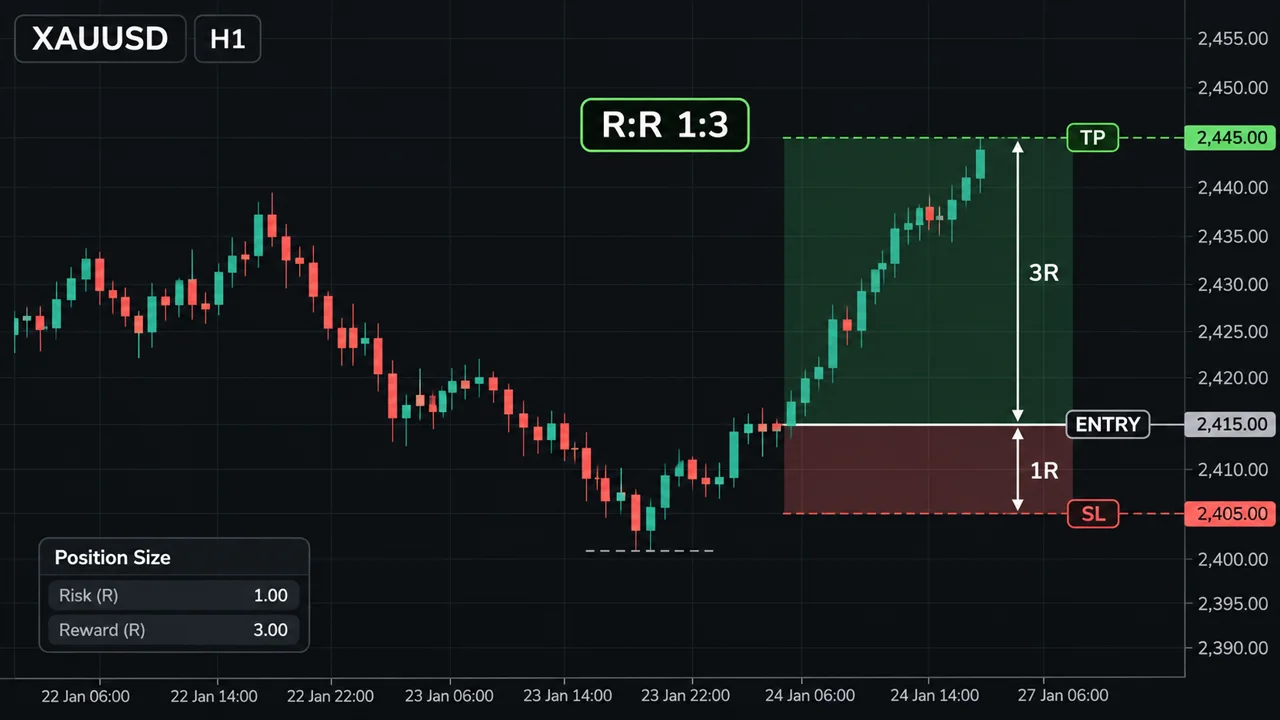
ตลาด: ทองคำ (XAUUSD) H1 เทรดช่วง 14:00–22:00 น. เวลาไทย ความเสี่ยง: 1% ต่อไม้ = $15 ลิมิตรายวัน 2% = $30 (แพ้ 2 ไม้ = หยุด) สูงสุด 3 ไม้ต่อวัน การคำนวณล็อต: ล็อต = เงินที่ยอมเสีย ÷ (ระยะ SL × $100 ต่อ 1 ล็อต) ถ้า SL ห่าง $6: $15 ÷ ($6 × $100) = 0.025 ล็อต ปัดลงเป็น 0.02 ล็อต ความเสี่ยงจริง $6 × $2 = $12 (ปัดลงเสมอ ไม่ปัดขึ้น) การออก: TP ที่ 2 เท่าของระยะ SL = $12 กำไรที่ 0.02 ล็อตคือ $12 × $2 = $24 กฎเพิ่ม: ห้ามขยาย SL ห้ามเปิดไม้ใหม่ 30 นาทีหลังโดน SL ทบทวนแผนทุกวันอาทิตย์ แผนแบบนี้สั้นพอเก็บไว้ในโน้ตมือถือ แต่ตอบคำถามสำคัญได้ครบก่อนกดปุ่ม
ดูภาพด้านล่าง ไม้หนึ่งไม้ตามแผนนี้
ปรับแผนอย่างไรให้ไม่เละ
- ห้ามแก้แผนระหว่างเทรด จดสิ่งที่อยากเปลี่ยนไว้ แล้วตัดสินใจตอนทบทวน
- เปลี่ยนทีละอย่าง ถ้าเปลี่ยนหลายอย่างพร้อมกัน จะไม่รู้ว่าอะไรได้ผล
- ใช้ข้อมูลจากบันทึก อย่างน้อยหลายสิบไม้ก่อนสรุปว่าอะไรต้องเปลี่ยน
- เก็บเวอร์ชันเก่า ใส่วันที่ทุกครั้งที่แก้ จะได้ย้อนดูได้
ข้อผิดพลาดที่พบบ่อย
- แผนอยู่แค่ในหัว แผนที่ไม่ได้เขียนจะถูกแก้เองเงียบ ๆ ทุกครั้งที่อารมณ์มา
- แผนยาวเกินไป สิบหน้าที่ไม่มีใครเปิดอ่าน มีค่าน้อยกว่าหนึ่งหน้าที่เปิดทุกวัน
- เป้าหมายเป็นเงินรายวัน เช่น "วันละ $50" ทำให้ฝืนเทรดในวันที่ไม่มีจังหวะ
- ไม่มีส่วนกฎหยุด แผนที่บอกแค่วิธีเข้า แต่ไม่บอกว่าเมื่อไหร่ต้องหยุด ยังไม่ครบ
- คิดว่าแผนทำให้กำไรแน่นอน แผนไม่ได้รับประกันผล มันแค่ทำให้ผลที่ได้มาจากระบบ ไม่ใช่จากอารมณ์ และทำให้วัดได้ว่าระบบได้ผลหรือไม่
ใช้บนมือถือ
เก็บแผนไว้ในแอปโน้ตแบบปักหมุด แล้วทำสำเนาส่วน "เช็กลิสต์เข้าไม้" แยกไว้อีกหน้าสั้น ๆ ถ้าต้องการคำนวณว่าลิมิตรายวันและล็อตสูงสุดที่เหมาะกับพอร์ตเป็นเท่าไหร่ ลองใช้ เครื่องคำนวณ ช่วยได้
สรุป
- แผนการเทรดคือกฎที่ตัดสินใจแทนอารมณ์
- ต้องมี: ตลาดและเวลา เงื่อนไขเข้า SL การออก ความเสี่ยง กฎหยุด และการทบทวน
- เงื่อนไขต้องวัดได้ ให้คนอื่นอ่านแล้วตัดสินใจเหมือนเรา
- แก้แผนนอกเวลาเทรด ทีละอย่าง ด้วยข้อมูลจากบันทึก
A trading plan is a document written in advance that says what you trade, when, how you enter, how you exit and how much you risk. Its job is to decide for you at the moments your emotions are strongest. Without one, every trade is a fresh decision made under pressure — the condition in which most people decide worst.
What a trading plan must contain
A good plan does not need to be long; one or two pages is enough. But it must be clear enough that someone else could follow it. The core sections:
- Goal and reason. Why you trade and how much time you have each day. A behaviour goal such as "follow the plan on 95% of trades" works better than a money goal.
- Markets and hours. Which pairs, which timeframe, which hours — and when you never trade, for example 15 minutes either side of major news.
- Entry conditions, written as items you can answer "yes" or "no" — "price above the 50-period moving average on H1," not "looks bullish."
- Stop placement — for example, below the last swing plus a buffer. See stop-loss placement.
- Exits — where the target is, whether you take partials, when the stop moves to breakeven.
- Risk and position size — what percentage per trade and how you calculate the lot. See position sizing.
- Stop rules — daily and weekly loss limits, maximum trades, how many losses in a row before a break.
- Routine and review — what you do before and after trading, and when you review the plan.
Writing conditions you can actually use
A good condition is measurable and needs no interpretation. Try this test: if a friend read your plan and looked at the same chart, would they make the same decision? If not, the condition is still vague.
| Vague | Clear |
|---|---|
| Price looks strong | Closes above the high of the last 20 candles |
| Stop somewhere safe | Stop $1 below the last swing low |
| Avoid news | No new trades 15 minutes before or after high-impact news |
| Don't risk too much | Risk 1% of balance per trade |
Market: gold (XAUUSD), H1, traded 14:00–22:00 Thai time. Risk: 1% per trade = $15. Daily limit 2% = $30 (two losses = stop). Maximum 3 trades a day. Lot formula: lot = money at risk ÷ (stop distance × $100 per 1.00 lot) With a $6 stop: $15 ÷ ($6 × $100) = 0.025 lots, rounded down to 0.02 lots. Actual risk: $6 × $2 = $12 (always round down, never up). Exit: target at twice the stop distance = $12. Profit at 0.02 lots = $12 × $2 = $24. Extra rules: never widen a stop; no new trade for 30 minutes after a stop-out; review the plan every Sunday. A plan like this fits in a phone note yet answers every important question before you press the button.
See the picture below: one trade taken under this plan.
Revising the plan without breaking it
- Never change the plan mid-session. Write down what you want to change and decide at review time.
- Change one thing at a time. Change several at once and you will not know what worked.
- Use journal data — at least several dozen trades — before concluding something needs to change.
- Keep old versions. Date every revision so you can look back.
Common mistakes
- A plan that lives only in your head. An unwritten plan quietly rewrites itself every time emotion arrives.
- A plan that is too long. Ten pages nobody opens are worth less than one page you open every day.
- A daily money target like "$50 a day," which pushes you to force trades on days with no setups.
- No stop-rules section. A plan that says how to enter but not when to stop is incomplete.
- Believing a plan guarantees profit. It does not. It makes your results come from the method rather than from emotion, so you can measure whether the method works.
On a phone
Keep the plan pinned in your notes app, and copy the entry checklist onto a separate short page. If you want to work out a sensible daily limit and maximum lot for your account, the calculator can help.
Summary
- A trading plan is a set of rules that decides instead of your emotions.
- It needs markets and hours, entry conditions, stop, exits, risk, stop rules and review.
- Conditions must be measurable — someone else should reach the same decision.
- Revise outside trading hours, one change at a time, using journal data.