ความเสี่ยงต่อไม้ (Risk per Trade)Risk per Trade
เข้าใจว่าทำไมควรกำหนดเงินที่ยอมเสียต่อไม้เป็นเปอร์เซ็นต์ของพอร์ต และตัวเลขเล็ก ๆ อย่าง 1% ช่วยให้รอดจากช่วงแพ้ติดกันได้อย่างไรWhy you should fix the amount you are willing to lose per trade as a percentage of your account, and how a small number like 1% keeps you alive through losing streaks.
ในบทความนี้ · 7
In this article · 7
ความเสี่ยงต่อไม้ (Risk per Trade) คือจำนวนเงินที่คุณยอมเสียถ้าไม้นั้นโดนตัดขาดทุน (Stop Loss) นี่คือการตัดสินใจที่สำคัญที่สุดในการบริหารเงิน เพราะมันกำหนดว่าพอร์ตของคุณจะทนช่วงแพ้ติดกันได้กี่ไม้ ก่อนจะคิดเรื่องจุดเข้า จุดออก หรืออินดิเคเตอร์ใด ๆ คุณต้องตอบให้ได้ก่อนว่า "ไม้นี้ถ้าผิด ฉันเสียเท่าไร"
ความเสี่ยงต่อไม้คืออะไร
เทรดเดอร์ส่วนใหญ่กำหนดความเสี่ยงเป็นเปอร์เซ็นต์ของเงินในพอร์ต (Balance หรือ Equity) เช่น 0.5%, 1% หรือ 2% ต่อไม้ แทนที่จะคิดเป็นจำนวนล็อตตายตัว
เงินที่ยอมเสียต่อไม้ = เงินในพอร์ต × เปอร์เซ็นต์ความเสี่ยง
ตัวอย่างเช่น พอร์ต $1,000 เสี่ยง 1% = ยอมเสีย $10 ต่อไม้ พอร์ต $5,000 เสี่ยง 1% = $50 ต่อไม้
จุดสำคัญคือ ตัวเลขนี้ ไม่ใช่ ขนาดล็อต ล็อตเป็นผลลัพธ์ที่คำนวณย้อนกลับมาจากเงินที่ยอมเสียและระยะ SL (ดูบทความ การคำนวณขนาดไม้) ถ้า SL กว้าง ล็อตต้องเล็กลง ถ้า SL แคบ ล็อตใหญ่ขึ้นได้ แต่เงินที่เสียเมื่อโดน SL ยังเท่าเดิม
ทำไมต้องเป็นเปอร์เซ็นต์เล็ก ๆ
ไม่มีระบบไหนชนะทุกไม้ ต่อให้ระบบมีความได้เปรียบจริง ก็ยังเจอช่วงแพ้ติดกัน 5, 8 หรือ 10 ไม้ได้ตามธรรมชาติของความน่าจะเป็น ตารางนี้แสดงว่าถ้าแพ้ติดกัน 10 ไม้ พอร์ต $1,000 จะเหลือเท่าไร (คิดแบบเสี่ยงเป็น % ของเงินที่เหลือทุกไม้)
| ความเสี่ยงต่อไม้ | สูตร | เหลือหลังแพ้ 10 ไม้ | ติดลบ |
|---|---|---|---|
| 1% | 1,000 × 0.99^10 | $904.38 | -9.6% |
| 2% | 1,000 × 0.98^10 | $817.07 | -18.3% |
| 5% | 1,000 × 0.95^10 | $598.74 | -40.1% |
| 10% | 1,000 × 0.90^10 | $348.68 | -65.1% |
ที่เสี่ยง 1% การแพ้ 10 ไม้เป็นเรื่องเจ็บแต่ยังแก้ไขได้ ที่เสี่ยง 10% พอร์ตหายไปเกือบสองในสาม และอย่างที่อธิบายในบทความ คณิตศาสตร์การฟื้นจากขาดทุน พอร์ตที่ติดลบ 65% ต้องทำกำไรเกือบ 187% เพื่อกลับมาที่เดิม
ดูภาพด้านล่าง: เส้นเดียวกันจากตาราง วาดเป็นพอร์ตที่ลดลงทีละไม้
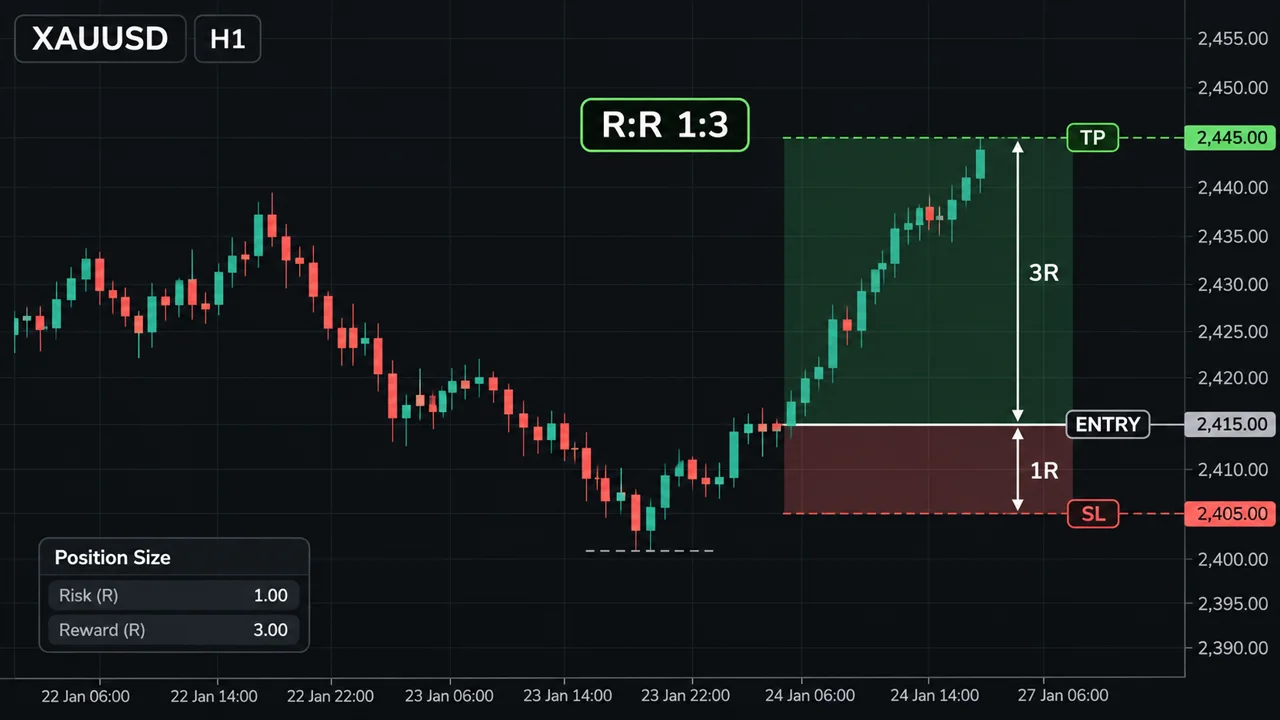
พอร์ต $1,000 ตั้งกฎเสี่ยง 1% = ยอมเสีย $10 ต่อไม้ คุณจะซื้อ XAUUSD และวาง SL ห่างจากจุดเข้า $5 (เช่น เข้า 1,950.00 SL 1,945.00) ทองคำ 0.01 ล็อต ราคาขยับ $1 = กำไร/ขาดทุน $1 ดังนั้น 0.01 ล็อต โดน SL $5 = เสีย $5 ล็อตที่ใช้ได้ = $10 ÷ ($5 × $1 ต่อ 0.01 ล็อต) = 2 หน่วย = 0.02 ล็อต ตรวจกลับ: 0.02 ล็อต × $5 = $2 ต่อ $1 × 5 = $10 ตรงกับ 1% พอดี
จะเลือกกี่เปอร์เซ็นต์ดี
ไม่มีตัวเลขเดียวที่ถูกสำหรับทุกคน แต่มีแนวคิดที่ใช้กันแพร่หลาย
- 0.25–0.5% เหมาะกับคนเพิ่งเริ่มเทรดเงินจริง หรือระบบที่ยังไม่ได้ทดสอบนาน
- 0.5–1% ช่วงที่เทรดเดอร์จำนวนมากใช้ เป็นจุดสมดุลระหว่างการเติบโตกับการทนแพ้ติดกัน
- 1–2% ใช้เมื่อมีสถิติของตัวเองยืนยันแล้ว และรับความผันผวนของพอร์ตได้
- เกิน 2% ช่วงแพ้ติดกันธรรมดาจะทำให้พอร์ตลดลงเร็วมาก ต้องเข้าใจผลลัพธ์ให้ชัดก่อน
สำหรับการสอบกองทุน (Prop Firm) ที่มีกฎขาดทุนรายวันและขาดทุนรวม ตัวเลขมักต้องเล็กกว่านี้ เพราะพื้นที่ให้ผิดพลาดมีจำกัด
ขั้นตอนใช้ในชีวิตจริง
- ตั้งเปอร์เซ็นต์ความเสี่ยงต่อไม้ล่วงหน้าและเขียนลงในแผนการเทรด
- ก่อนเข้าไม้ หาจุด SL จากโครงสร้างราคาก่อน (ไม่ใช่ปรับ SL ให้เข้ากับล็อตที่อยากเทรด)
- คำนวณล็อตจากเงินที่ยอมเสียและระยะ SL ปัดลงเสมอ
- รวมค่าสเปรด (Spread) และค่าคอมมิชชั่นเข้าไปในความเสี่ยงด้วย ถ้าเป็นไม้สั้น ๆ ต้นทุนส่วนนี้มีผลมาก
- ทบทวนตัวเลขเมื่อพอร์ตเปลี่ยนมาก เช่น ทุกต้นสัปดาห์หรือต้นเดือน
จุดอ่อน / ข้อผิดพลาดที่พบบ่อย
- คิดเป็นล็อตตายตัว เช่น "เทรด 0.10 ทุกไม้" ทำให้ไม้ที่ SL กว้างเสี่ยงมากกว่าไม้ที่ SL แคบหลายเท่าโดยไม่รู้ตัว
- ขยับ SL หนีราคา ทำให้ความเสี่ยงจริงสูงกว่าที่วางแผนไว้ กฎ 1% ไม่มีความหมายถ้า SL ไม่ถูกเคารพ
- SL ไม่การันตีราคา ในช่วงข่าวแรงหรือตลาดเปิดต้นสัปดาห์ ราคาอาจกระโดดข้าม SL (Slippage / Gap) ทำให้เสียมากกว่าที่คำนวณ
- เปิดหลายไม้ที่ไปทางเดียวกัน เช่น ซื้อทองคำ 3 ไม้ ไม้ละ 1% จริง ๆ คือเสี่ยง 3% กับความคิดเดียว
- เพิ่มความเสี่ยงเพื่อเอาคืน หลังแพ้ติดกัน คือเส้นทางที่พาพอร์ตพังเร็วที่สุด
ไม้ที่ไม่มี SL มีความเสี่ยงต่อไม้เท่ากับ "ทั้งพอร์ต" ไม่ว่าล็อตจะเล็กแค่ไหนก็ตาม
ใช้บนมือถือ
แอป MT4/MT5 บนมือถือไม่มีเครื่องคิดเลขความเสี่ยงในตัว ให้จำสูตรง่าย ๆ สำหรับทองคำว่า "0.01 ล็อต = $1 ต่อราคาขยับ $1" และสำหรับ EURUSD "0.01 ล็อต = $0.10 ต่อ 1 pip" แล้วคำนวณด้วยเครื่องคิดเลขในมือถือก่อนกดส่งคำสั่ง ตั้ง SL ตั้งแต่ตอนเปิดออเดอร์ทุกครั้ง อย่าคิดว่าจะ "ค่อยมาตั้งทีหลัง"
สรุป
- ความเสี่ยงต่อไม้ = เงินที่ยอมเสียถ้าโดน SL คิดเป็น % ของพอร์ต
- ล็อตเป็นผลลัพธ์จากความเสี่ยงและระยะ SL ไม่ใช่สิ่งที่เลือกก่อน
- 0.5–1% ต่อไม้ช่วยให้พอร์ตทนช่วงแพ้ติดกันได้ ส่วน 5–10% ทำให้แพ้ 10 ไม้ติดเสียหายหนักมาก
- นับรวมไม้ที่ไปทางเดียวกันเป็นความเสี่ยงก้อนเดียว
- ไม่มี SL = เสี่ยงทั้งพอร์ต
Risk per trade is the amount of money you will lose if a trade hits its stop loss. It is the single most important money-management decision you make, because it decides how many losing trades in a row your account can survive. Before you think about entries, exits or indicators, you should be able to answer one question: "If this trade is wrong, how much do I lose?"
How it works
Most traders set risk as a percentage of the account (balance or equity), for example 0.5%, 1% or 2% per trade, rather than as a fixed lot size.
Money at risk per trade = account size × risk percentage
So a $1,000 account risking 1% risks $10 per trade. A $5,000 account risking 1% risks $50.
The key point: this number is not your lot size. The lot size is calculated backwards from the money at risk and the stop-loss distance (see Position Sizing). A wide stop means a smaller lot; a tight stop allows a larger lot. Either way, the money lost at the stop is the same.
Why a small percentage
No system wins every trade. Even a strategy with a real edge will hit runs of 5, 8 or 10 losses simply because of probability. The table shows what is left of a $1,000 account after 10 straight losses, when each trade risks a percentage of the remaining balance.
| Risk per trade | Formula | Left after 10 losses | Change |
|---|---|---|---|
| 1% | 1,000 × 0.99^10 | $904.38 | -9.6% |
| 2% | 1,000 × 0.98^10 | $817.07 | -18.3% |
| 5% | 1,000 × 0.95^10 | $598.74 | -40.1% |
| 10% | 1,000 × 0.90^10 | $348.68 | -65.1% |
At 1%, ten losses hurt but are recoverable. At 10%, almost two thirds of the account is gone, and as Drawdown Recovery Math explains, an account down 65% needs a gain of almost 187% just to get back to where it started.
See the chart below: the same table drawn as an account shrinking trade by trade.
Account $1,000, rule: risk 1% = $10 per trade. You want to buy XAUUSD with the stop $5 away from entry (say entry 1,950.00, stop 1,945.00). On gold, 0.01 lot makes or loses $1 per $1 move, so 0.01 lot stopped out after $5 loses $5. Lot you can use = $10 ÷ ($5 × $1 per 0.01 lot) = 2 units = 0.02 lot. Check: 0.02 lot = $2 per $1 move × 5 = $10, exactly 1%.
Choosing a percentage
There is no single right number, but these ranges are widely used:
- 0.25–0.5% for traders new to live money, or a system without much testing behind it.
- 0.5–1% the range many traders use, a balance between growth and surviving losing streaks.
- 1–2% when you have your own statistics confirming the system and can live with bigger swings.
- Above 2% an ordinary losing streak shrinks the account very quickly; understand the numbers first.
Prop firm challenges, with their daily and overall loss limits, usually call for smaller numbers still, because the room for error is fixed.
Applying it step by step
- Decide your risk percentage in advance and write it into your trading plan.
- Before entering, find your stop from price structure first (do not bend the stop to fit the lot you want).
- Calculate the lot from the money at risk and the stop distance. Always round down.
- Include spread and commission in the risk. On short-term trades these costs matter a lot.
- Re-check the numbers when your account changes meaningfully, for example weekly or monthly.
Weaknesses and common mistakes
- Thinking in fixed lots, such as "0.10 on every trade", silently makes wide-stop trades many times riskier than tight-stop ones.
- Moving the stop away from price makes the real risk bigger than planned. A 1% rule means nothing if the stop is not respected.
- A stop is not a guaranteed price. During big news or the weekly open, price can jump past the stop (slippage or a gap) and you lose more than calculated.
- Several trades in the same direction, like three gold buys at 1% each, are really 3% on one idea.
- Raising risk to win it back after a losing run is the fastest way to destroy an account.
A trade without a stop risks the whole account, however small the lot.
On a phone
The MT4/MT5 mobile apps have no built-in risk calculator. Remember two simple facts: on gold, 0.01 lot = $1 per $1 move; on EURUSD, 0.01 lot = $0.10 per pip. Do the sum on your phone calculator before you send the order, and set the stop loss in the order ticket itself. Do not plan to "add it later".
Summary
- Risk per trade = money lost at the stop, set as a percentage of the account.
- Lot size is the result of risk and stop distance, not the starting point.
- 0.5–1% per trade lets an account survive losing streaks; 5–10% makes ten losses devastating.
- Count trades in the same direction as one combined risk.
- No stop loss means the whole account is at risk.