Fair Value Gap (FVG) ช่องว่างราคาที่ถูกพูดถึงมากFair Value Gaps (FVG)
รู้วิธีหา FVG จากแท่งเทียน 3 แท่ง วิธีที่เทรดเดอร์ใช้เป็นจุดเข้า และข้อจำกัดที่ทำให้มันไม่ใช่สัญญาณที่แม่นยำเสมอไปLearn how to spot a fair value gap from three candles, how traders use it for entries, and the limits that stop it from being a reliable signal on its own.
ในบทความนี้ · 6
In this article · 6
Fair Value Gap หรือ FVG เป็นแนวคิดที่มาจากสาย ICT และ SMC หมายถึงช่วงราคาที่ตลาดวิ่งผ่านไปเร็วมากจนเกิด "ช่องว่าง" ที่มีการซื้อขายน้อยฝั่งเดียว หลายคนเชื่อว่าราคามักกลับมาเติมช่องว่างนี้ก่อนไปต่อ จึงใช้เป็นจุดรอเข้า บทความนี้อธิบายว่า FVG วัดอย่างไร ใช้อย่างไร และควรระวังอะไร
FVG คืออะไร
FVG ดูจากแท่งเทียน 3 แท่งติดกัน โดยแท่งกลางเป็นแท่งยาวที่วิ่งแรง
- Bullish FVG (ช่องว่างขาขึ้น) เกิดเมื่อ ราคาต่ำสุด (Low) ของแท่งที่ 3 สูงกว่าราคาสูงสุด (High) ของแท่งที่ 1 ช่องว่างคือระหว่าง High แท่ง 1 ถึง Low แท่ง 3
- Bearish FVG (ช่องว่างขาลง) เกิดเมื่อ ราคาสูงสุดของแท่งที่ 3 ต่ำกว่าราคาต่ำสุดของแท่งที่ 1 ช่องว่างคือระหว่าง Low แท่ง 1 ถึง High แท่ง 3
ในช่องว่างนั้น ไส้เทียนของแท่ง 1 และแท่ง 3 ไม่ซ้อนกัน มีแต่ตัวแท่งกลางที่วิ่งผ่าน แปลว่าราคาผ่านช่วงนั้นไปอย่างรวดเร็ว คนในสาย ICT เรียกว่า "ไม่มีประสิทธิภาพ" (Imbalance หรือ Inefficiency)
สิ่งที่ต้องเข้าใจคือ FVG เป็นแค่ลักษณะทางเรขาคณิตของแท่งเทียน ไม่ได้บอกว่ามีคำสั่งค้างอยู่จริง ในตลาด Forex ที่เปิดตลอด ช่องว่างแบบนี้คือการวิ่งเร็ว ไม่ใช่ราคากระโดดข้าม (Gap) แบบตลาดหุ้นที่เปิดปิดรายวัน
ความเชื่อเบื้องหลัง
แนวคิดที่สอนกันคือ เมื่อราคาวิ่งแรงเกินไป ตลาดจะกลับมา "ปรับสมดุล" ที่ช่วงนั้นก่อน (Rebalance) แล้วค่อยไปต่อในทิศเดิม เทรดเดอร์จึงรอราคากลับมาในช่องว่าง แทนการไล่ซื้อที่ปลายแท่งยาว
บางครั้งราคาก็กลับมาเติมเต็มช่อง บางครั้งแตะแค่ขอบ บางครั้งทะลุช่องไปเลยแล้วกลับทิศ ไม่มีกฎตายตัว
วิธีที่เทรดเดอร์ใช้ FVG
- หาทิศหลักก่อน ใช้โครงสร้างตลาดบนไทม์เฟรมใหญ่ FVG ในทิศเดียวกับเทรนด์ถือว่ามีน้ำหนักกว่า
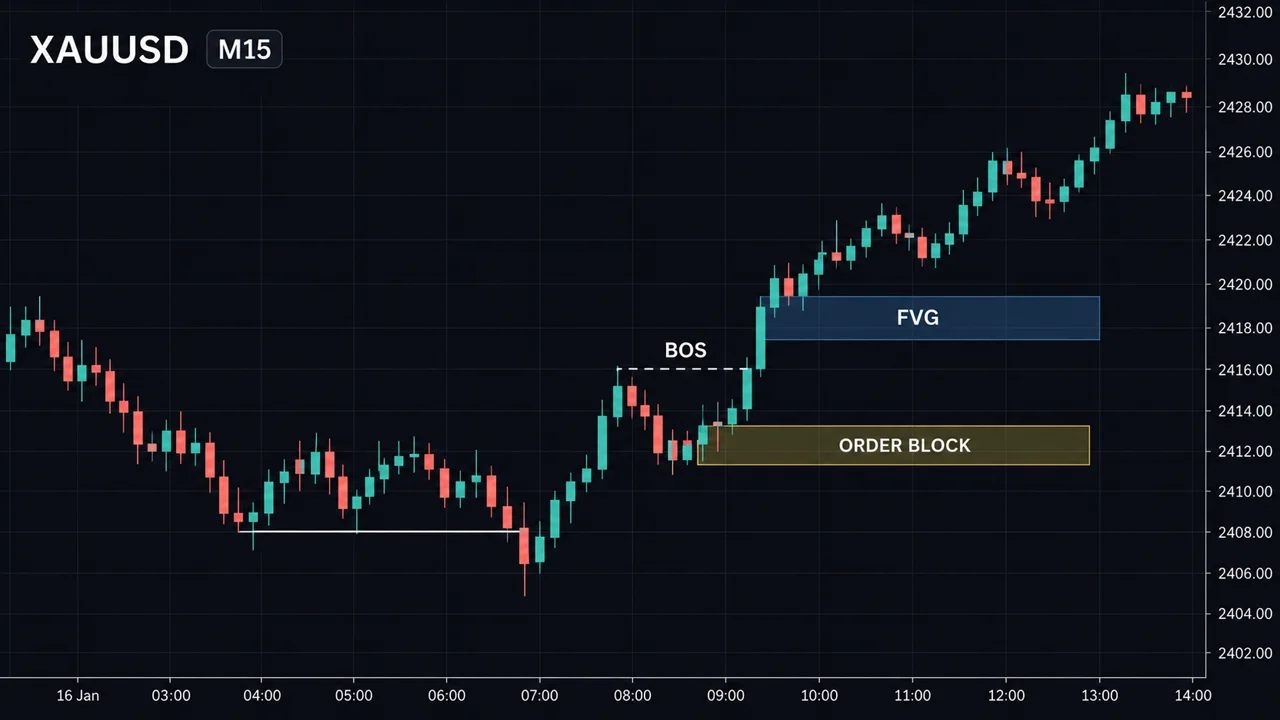
- เลือก FVG ที่เกิดจากการวิ่งที่ทำลายโครงสร้าง (BOS) ไม่ใช่ช่องเล็ก ๆ กลางกรอบไซด์เวย์
- กำหนดจุดเข้า มี 3 แบบหลัก: ขอบใกล้สุดของช่อง, กลางช่อง (50% หรือ Consequent Encroachment), หรือรอแท่งยืนยันในช่อง
- วาง SL นอกช่องอีกฝั่ง หรือเลยไส้ของแท่งที่ 1 ซึ่งกว้างกว่าแต่ปลอดภัยกว่า
- ยกเลิกแผน ถ้าราคาปิดทะลุช่องทั้งช่องในไทม์เฟรมที่ใช้ ถือว่า FVG นั้นใช้ไม่ได้แล้ว
FVG มักใช้คู่กับ Order Block คือถ้า OB และ FVG ซ้อนกันในโซนเดียว คนในสายนี้มองว่าน่าสนใจขึ้น
บน M15 แท่งที่ 1 มี High 1.0850 แท่งที่ 2 วิ่งขึ้นยาว แท่งที่ 3 มี Low 1.0872 Low แท่ง 3 (1.0872) สูงกว่า High แท่ง 1 (1.0850) → เป็น Bullish FVG ขนาด 1.0872 − 1.0850 = 0.0022 = 22 pips กลางช่อง = 1.0850 + 0.0011 = 1.0861 → ตั้ง Buy Limit ที่ 1.0861 SL ที่ 1.0840 → ระยะ 1.0861 − 1.0840 = 21 pips · TP ที่ 1.0903 → ระยะ 42 pips → RR = 1 : 2 บัญชี 1,000 ดอลลาร์ ยอมเสีย 1% = 10 ดอลลาร์ · 1.00 ล็อต = 10 ดอลลาร์ต่อ pip ล็อต = 10 ÷ (21 × 10) = 0.0476 → ปัดลงเป็น 0.04 ล็อต (0.40 ดอลลาร์ต่อ pip) ถ้าโดน SL เสีย 21 × 0.40 = 8.40 ดอลลาร์ · ถ้าถึง TP ได้ 42 × 0.40 = 16.80 ดอลลาร์ (ก่อนหักสเปรด)
ดูภาพด้านล่าง
ถ้าราคาไม่ย้อนลงมาถึง 1.0861 เลย ออเดอร์ก็ไม่ถูกเปิด ซึ่งเป็นเรื่องปกติ การพลาดบางการวิ่งคือราคาของการรอจุดเข้าที่ดี
จุดอ่อน / ข้อผิดพลาดที่พบบ่อย
- มี FVG เยอะมาก บนไทม์เฟรมเล็ก แทบทุกการวิ่งแรงจะสร้าง FVG ถ้าไม่กรอง จะเหมือนเห็นสัญญาณตลอดเวลา
- "ราคาต้องกลับมาเติม" ไม่จริงเสมอ บางช่องไม่เคยถูกเติมเลย หรือเติมหลังจากผ่านไปนานจนไม่มีความหมายต่อแผน
- ไม่มีสถิติรองรับที่เชื่อถือได้ ยังไม่มีงานศึกษาสาธารณะที่ชัดเจนว่าการเข้าที่ FVG ให้ผลดีกว่าการสุ่มจุดเข้าในทิศเดียวกัน ถ้าจะใช้ต้องทดสอบด้วยกฎของตัวเอง
- สับสนเรื่องไทม์เฟรม FVG บน M5 อาจอยู่กลางแท่งเดียวบน H4 ช่องเดียวกันมีความหมายต่างกันตามไทม์เฟรม
- นับไส้เทียนผิด ต้องใช้ High/Low ของแท่ง 1 และ 3 ไม่ใช่ราคาเปิดปิด ถ้าใช้ตัวแท่งจะได้ช่องที่ผิด
- สเปรดกินช่องเล็ก ช่อง 3–5 pips บนคู่ที่สเปรด 1–2 pips แทบไม่มีที่ให้วาง SL อย่างมีเหตุผล
ถ้าเข้าทุก FVG ที่เห็น จะเทรดถี่เกินไปและเสียค่าสเปรดสะสมมาก เลือกเฉพาะช่องที่ผ่านเกณฑ์ที่เขียนไว้ล่วงหน้าเท่านั้น
ใช้บนมือถือ
FVG ดูยากบนจอเล็กเพราะต้องเห็นไส้เทียน 3 แท่งชัด ๆ ให้ซูมเข้าจนแท่งกว้างพอ แตะดูค่า High/Low ด้วยเส้นเล็ง (Crosshair) แล้วจดตัวเลขก่อนตั้งคำสั่ง ถ้าจะลองดูว่าในอดีตราคาเคลื่อนต่อจากจุดคล้าย ๆ กันอย่างไร ใช้ หน้าวิเคราะห์ภาพกราฟ ประกอบได้
สรุป
- FVG ดูจาก 3 แท่ง: ไส้แท่ง 1 กับแท่ง 3 ไม่ซ้อนกัน เกิดช่องว่างจากการวิ่งเร็ว
- เทรดเดอร์รอราคากลับมาในช่องเพื่อเข้าตามทิศเดิม มักใช้ขอบหรือกลางช่อง
- ต้องกรองด้วยเทรนด์ใหญ่และโครงสร้าง ไม่อย่างนั้นสัญญาณจะเยอะเกินไป
- ราคาไม่จำเป็นต้องกลับมาเติมช่องเสมอ เป็นการตีความ ไม่ใช่กฎของตลาด
- ทดสอบกฎของตัวเองก่อนใช้เงินจริง
A Fair Value Gap (FVG) is a concept from the ICT and SMC schools. It describes a price range that the market moved through so quickly that trading happened mostly on one side, leaving a "gap" on the chart. Many traders believe price tends to return to fill that gap before continuing, so they use it as a place to wait for an entry. This article covers how to measure an FVG, how it is used, and what to watch out for.
What an FVG is
An FVG is read from three consecutive candles, with the middle candle being a long, fast one.
- Bullish FVG — appears when the low of candle 3 is above the high of candle 1. The gap runs from candle 1's high to candle 3's low.
- Bearish FVG — appears when the high of candle 3 is below the low of candle 1. The gap runs from candle 1's low to candle 3's high.
Inside that range the wicks of candles 1 and 3 do not overlap; only the body of the middle candle passed through. ICT followers call this an imbalance or inefficiency.
Keep in mind that an FVG is simply a geometric feature of candles. It does not prove that any orders are waiting there. In forex, which trades around the clock, these gaps come from fast movement, not from the overnight price jumps you see in stock markets that open and close daily.
The belief behind it
The teaching is that when price moves too fast, the market will come back to "rebalance" that area before resuming in the original direction. So instead of buying at the end of a long candle, traders wait for price to return into the gap.
Sometimes price fills the gap fully, sometimes it only touches the edge, and sometimes it slices straight through and reverses. There is no fixed rule.
How traders use FVGs
- Find the main direction first. Use higher-timeframe market structure. An FVG in the trend direction is given more weight.
- Prefer FVGs created by a structure-breaking move (BOS), not tiny gaps in the middle of a sideways range.
- Choose an entry. Three common options: the near edge of the gap, the middle of the gap (50%, called "consequent encroachment"), or waiting for a confirming candle inside it.
- Place the stop beyond the far side of the gap, or beyond candle 1's wick, which is wider but safer.
- Cancel the idea if price closes completely through the gap on your timeframe; that FVG is no longer valid.
FVGs are often combined with order blocks. When an OB and an FVG overlap in the same zone, followers of this school see it as more interesting.
On M15, candle 1 has a high of 1.0850, candle 2 rallies hard, and candle 3 has a low of 1.0872. Candle 3's low (1.0872) is above candle 1's high (1.0850), so this is a bullish FVG of 1.0872 − 1.0850 = 0.0022 = 22 pips. Middle of the gap = 1.0850 + 0.0011 = 1.0861 → Buy Limit at 1.0861. Stop at 1.0840 → 1.0861 − 1.0840 = 21 pips. Target at 1.0903 → 42 pips. Risk:reward = 1 : 2. Account $1,000, risking 1% = $10. 1.00 lot = $10 per pip. Lot = 10 ÷ (21 × 10) = 0.0476 → round down to 0.04 lot ($0.40 per pip). If stopped: 21 × 0.40 = $8.40 lost. If the target is hit: 42 × 0.40 = $16.80 gained (before spread).
See the chart below.
If price never dips back to 1.0861, the order simply never fills. That is normal; missing some moves is the price of waiting for a better entry.
Weaknesses and common mistakes
- FVGs are everywhere. On low timeframes almost every strong push creates one. Without filters it feels like there is a signal all the time.
- "Price must come back" is not always true. Some gaps are never filled, or are filled so much later that it no longer matters to your plan.
- No reliable statistics behind it. There is no clear public study showing that entering at FVGs beats a random entry in the same direction. If you want to use it, test your own rules.
- Timeframe confusion. An FVG on M5 might sit inside a single H4 candle. The same gap means different things on different timeframes.
- Measuring the wrong part of the candle. Use the highs and lows of candles 1 and 3, not opens and closes. Using bodies gives the wrong gap.
- Spread eats small gaps. A 3–5 pip gap on a pair with a 1–2 pip spread leaves almost no room for a sensible stop.
Entering every FVG you see means overtrading and paying a lot of spread. Take only the gaps that pass rules you wrote down in advance.
On a phone
FVGs are hard to see on a small screen because you need three clear wicks. Zoom in until the candles are wide enough, use the crosshair to read the exact highs and lows, and write the numbers down before placing an order. To see how price behaved after similar setups in the past, the chart analysis page can help.
Summary
- An FVG uses three candles: the wicks of candle 1 and candle 3 do not overlap, leaving a gap from a fast move.
- Traders wait for price to return into the gap and enter in the original direction, often at the edge or the middle.
- Filter by higher-timeframe trend and structure, or you will have far too many signals.
- Price does not have to fill the gap; it is an interpretation, not a law of the market.
- Test your own rules before risking real money.